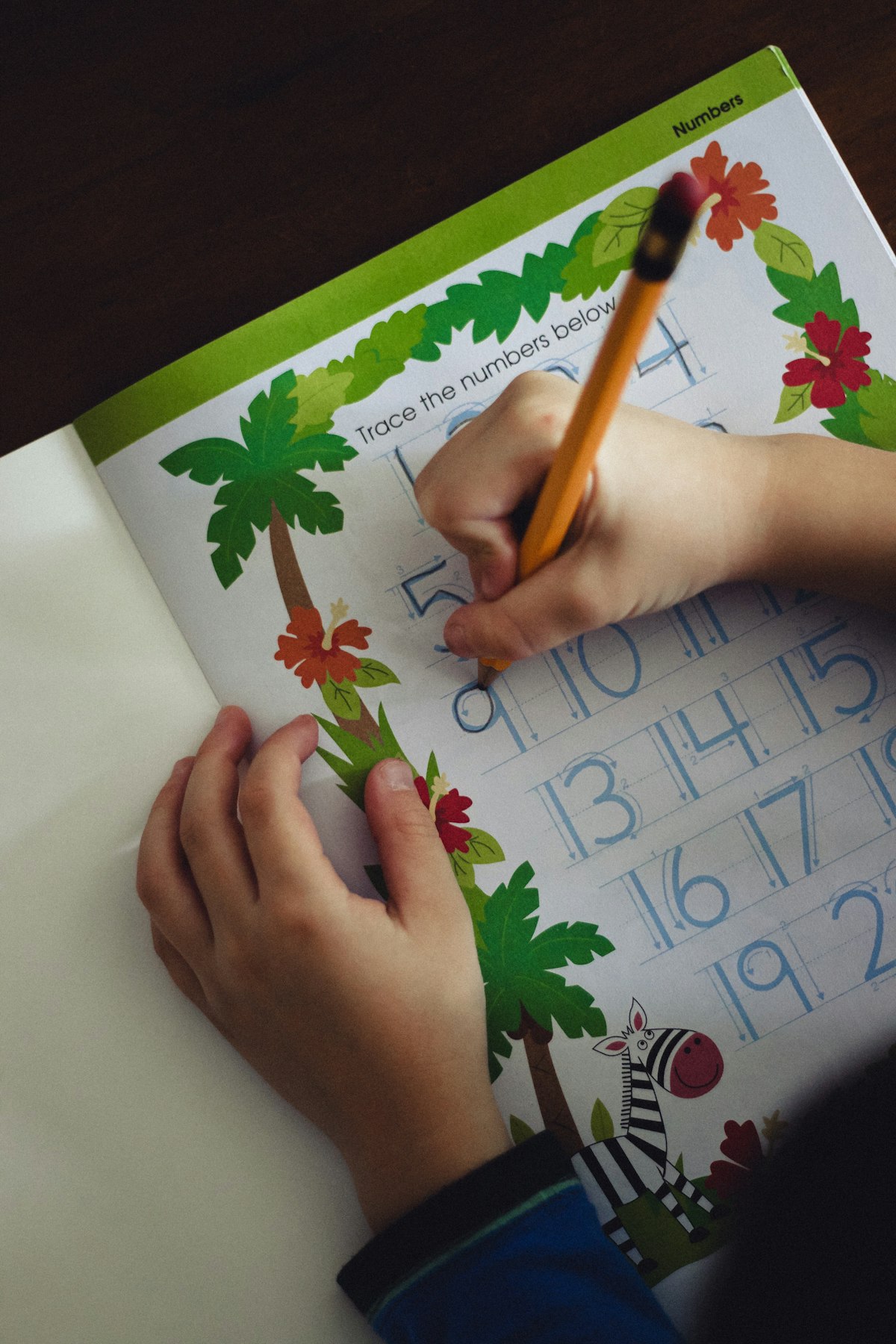
How do you teach a left-handed child to write? Tilt the paper 30-45 degrees clockwise, position the child's hand below the writing line, and place the pencil grip about one inch from the tip.
These three adjustments prevent smudging, reduce fatigue, and build confidence from the start.
Most handwriting curricula are written with right-handed students in mind. When a left-handed child enters a classroom and receives the same instruction as their right-handed peers, they are effectively being asked to mirror a system that was not designed for them. The result can range from messy handwriting and smeared pages to genuine anxiety about writing. With a few deliberate adjustments, parents and teachers can set left-handed children up for confident, comfortable handwriting from the very beginning.
Recognizing left-handedness in young children
Hand dominance is not always firmly established until age five or six, though many children show a strong preference earlier. Before formal handwriting instruction begins, observe which hand the child naturally reaches for when picking up objects, feeding themselves, or drawing.
Signs of left-hand dominance
- Consistently reaches for toys, utensils, and crayons with the left hand.
- Uses the left hand for precise tasks like stacking blocks or turning pages.
- Leads with the left foot when kicking a ball.
- Shows greater strength or coordination in the left hand during two-handed activities.
What if the child seems ambidextrous?
Some children switch hands frequently. This is normal before age four. If the pattern continues past five, gently encourage the child to pick one hand for writing rather than alternating. Alternating can delay the development of fine motor skills in either hand. If you are unsure, an occupational therapist can provide a formal assessment.
Crucially, never pressure a left-handed child to switch to the right hand. Forced switching has a long and harmful history. Our article on left-handed discrimination explores how this practice has affected generations of left-handers.
Setting up the writing environment
Before a child picks up a pencil, the physical setup needs to be right. An incorrect setup is the root cause of most left-handed writing difficulties.
Paper position
Tilt the paper so the top-right corner is higher than the top-left, rotating it roughly 30 to 45 degrees clockwise. This angle lets the child's hand sit below the writing line rather than curling over it. Place the paper slightly to the left of the child's body center so the writing arm can move freely.
Seating
The child's feet should be flat on the floor and the desk surface should be at elbow height. A chair that is too high forces the child to reach up, which encourages wrist hooking. A chair that is too low causes hunching.
Lighting
If using a desk lamp, place it on the right side. A lamp on the left casts the child's hand shadow directly onto the writing area.
Desk seating in the classroom
In a classroom, seat the left-handed child on the left side of a shared desk. This prevents elbow collisions with a right-handed neighbor. If the desk has a fixed armrest or writing surface on the right side only, provide an alternative. These small accommodations signal to the child that their handedness is normal, not a problem to work around.
Teaching the correct pencil grip
The tripod grip, holding the pencil between the thumb and index finger with the middle finger supporting from below, is the standard recommendation for both left- and right-handed children. The differences for left-handers are in finger distance and wrist angle.
Step-by-step grip instruction
- Have the child lay the pencil on the desk pointing away from them.
- Ask them to pick it up by pinching it between the thumb and index finger about 2 to 3 centimeters (roughly one inch) from the tip.
- The middle finger rests underneath for support.
- The ring and pinky fingers curl lightly into the palm.
- The wrist stays straight, not hooked. The pencil should point back toward the left shoulder.
Grip aids
Triangular pencil grips made of soft rubber can help young children find and maintain the correct finger position. Triangular-barreled pencils achieve the same effect without an additional accessory. Avoid grips designed for right-handers, as the molded finger positions will be reversed.
The importance of grip distance
Left-handed children benefit from holding the pencil slightly farther from the tip than right-handers. This gives them a clear view of the letters they are forming. If the child grips too close to the tip, their fingers will obscure the text and they may compensate by hooking the wrist overhead.
Paper angle and hand position: avoiding the hook
The hooked wrist, where the child curls the hand above the writing line, is the most common compensatory habit in left-handed writers. It develops when the paper is flat or tilted in the wrong direction, forcing the child to reach over the text to avoid smudging.
The fix is prevention. If the paper is angled correctly from the first day of handwriting instruction, the hook rarely develops. If a child has already started hooking, it can be corrected, but it requires patient, consistent practice over several weeks. For more detailed technique guidance, see our full guide on how to write left-handed.
Letter formation for left-handers
Most handwriting programs teach letter strokes that flow naturally for right-handers. Left-handed children may need modified stroke directions for some letters, though many strokes work identically for both hands.
Letters that work the same way
Most lowercase letters that begin with a downstroke, such as b, h, k, l, and t, are formed identically by left- and right-handed writers. The vertical downstroke is comfortable for both.
Letters that may need adjustment
Letters involving a left-to-right horizontal stroke, such as the crossbar on t and f, can feel awkward for left-handers because the hand pushes the pencil rather than pulling it. Allow the child to cross from right to left if it feels more natural. The finished letter looks the same regardless of stroke direction.
Circular letters
Letters like o, a, d, and g begin with a counterclockwise curve in standard handwriting instruction. This direction works well for left-handers and typically does not need modification.
Avoiding mirror writing
Mirror writing, where letters or entire words appear reversed as if seen in a mirror, is common in young left-handed children. It occurs because the natural left-to-right pulling motion for a right-hander becomes a right-to-left pulling motion for a left-hander.
- Place a green dot on the left margin of the page to mark where writing starts.
- Use arrow stickers or printed arrows showing the left-to-right direction of writing.
- Practice individual letters that are frequently reversed, especially b/d, p/q, and the numerals 3 and 7.
- Be patient. Mirror writing usually resolves on its own by age seven or eight with gentle correction.
Choosing the right tools
The writing instruments and materials a child uses can either support or undermine good technique.
Pencils
Standard No. 2 (HB) pencils work fine. Softer leads (B or 2B) lay down graphite more smoothly but smudge more easily. Harder leads (H or 2H) smudge less but require more pressure. For young left-handers, an HB pencil is the best balance.
Pens
When the child transitions to pen, choose a quick-drying ballpoint or gel pen. Avoid wet ink rollerballs and markers until the child has established good hand position habits. For specific recommendations, see our guide to the best left-handed pens.
Notebooks
Standard spiral notebooks with the binding on the left are a persistent nuisance for left-handed writers. The coil digs into the writing hand and wrist. Top-bound notebooks, composition books with sewn bindings, or notebooks designed for left-handers with the spiral on the right side all eliminate this problem.
Scissors
While not directly related to writing, classroom scissor use often accompanies handwriting activities. Right-handed scissors obscure the cutting line for left-handers and require an unnatural grip. Provide left-handed scissors for cutting tasks.
Emotional support and encouragement
A left-handed child in a right-handed world will inevitably notice differences. How adults frame those differences has a lasting impact.
What to say
- "Lots of people write with their left hand. We just set things up a little differently."
- "Your handwriting is improving. Look at how much neater this line is compared to last week."
- "It is okay that your paper is tilted differently from your neighbor's. That is how left-handers write best."
What not to do
- Never try to switch the child to the right hand. This practice is outdated and psychologically harmful. It can cause stuttering, reading difficulties, and lasting frustration.
- Do not single the child out negatively. Correcting hand position should be done privately and positively, not in front of the class.
- Do not lower expectations. Left-handed children can develop handwriting that is every bit as neat and fast as their right-handed peers. The tools and setup just need to be appropriate.
- Do not ignore the difference entirely. Pretending that handedness does not matter and providing no accommodations is a form of neglect. A few simple adjustments make a significant difference.
Working with the school
If your child's teacher is unfamiliar with left-handed writing instruction, share the basics: paper angle, grip distance, and seating placement. Most teachers are receptive when the information is presented constructively. You can also share a printed version of this guide or our companion article on left-handed writing technique.
If the school provides handwriting workbooks with right-handed stroke models, ask whether a left-handed supplement is available. Some publishers produce left-handed editions of popular handwriting programs.
Practice activities beyond traditional handwriting
Handwriting practice does not have to mean copying lines of text repeatedly. Varied activities keep children engaged while building the same fine motor skills.
- Tracing. Print large letter outlines and have the child trace them with a finger first, then a pencil.
- Sand or salt writing. Fill a shallow tray with sand or salt and let the child form letters with their finger. This builds muscle memory without the pressure of producing neat work on paper.
- Drawing. Free drawing with crayons and markers develops grip strength and hand control. Let the child draw whatever they like.
- Chalkboard writing. Writing on a vertical surface engages different muscles and helps develop whole-arm movement, which supports smoother handwriting later.
- Journaling. Once the child can form letters, encourage a daily journal, even if it is just a sentence or two. The habit of regular writing matters more than volume.
When to seek professional help
Most left-handed writing challenges resolve with proper instruction and practice. However, if a child shows persistent difficulty with fine motor tasks despite consistent support, a pediatric occupational therapist can evaluate whether an underlying motor coordination issue is involved. Signs that warrant a referral include an inability to hold a pencil with a functional grip by age six, extreme frustration or avoidance of all writing tasks, or persistent letter reversals past age eight.
Frequently asked questions
At what age should I start teaching a left-handed child to write?
Most children are ready for formal letter formation between ages four and six. Before that, focus on pre-writing activities like drawing, coloring, and playing with modeling clay to build hand strength. Introducing the correct paper angle and pencil grip from the very first writing lesson prevents bad habits from forming.
Is mirror writing a sign of a learning disability?
Occasional mirror writing is normal in children under seven, and it is more common in left-handers than right-handers. It is not, by itself, a sign of dyslexia or another learning disability. If mirror writing persists past age eight despite consistent correction, discuss it with the child's teacher or pediatrician for further evaluation.
Should I buy special left-handed pencils?
Dedicated left-handed pencils are not necessary for most children. A standard triangular-barreled pencil in HB hardness works well. What matters more is the grip distance, about one inch from the tip, and the paper angle. If the child struggles with grip, an inexpensive triangular rubber grip aid is usually sufficient. For pens later on, see our pen recommendations.
My child already hooks their wrist. Can it be fixed?
Yes. The hook grip can be corrected, but it takes patience. Start by adjusting the paper angle to 30 to 45 degrees clockwise and gently encouraging the child to keep their wrist below the writing line. Use short practice sessions of five to ten minutes so the new position does not cause frustration. Most children adapt within three to six weeks of consistent practice. Avoid criticizing the old habit; instead, praise the new position when you see it.