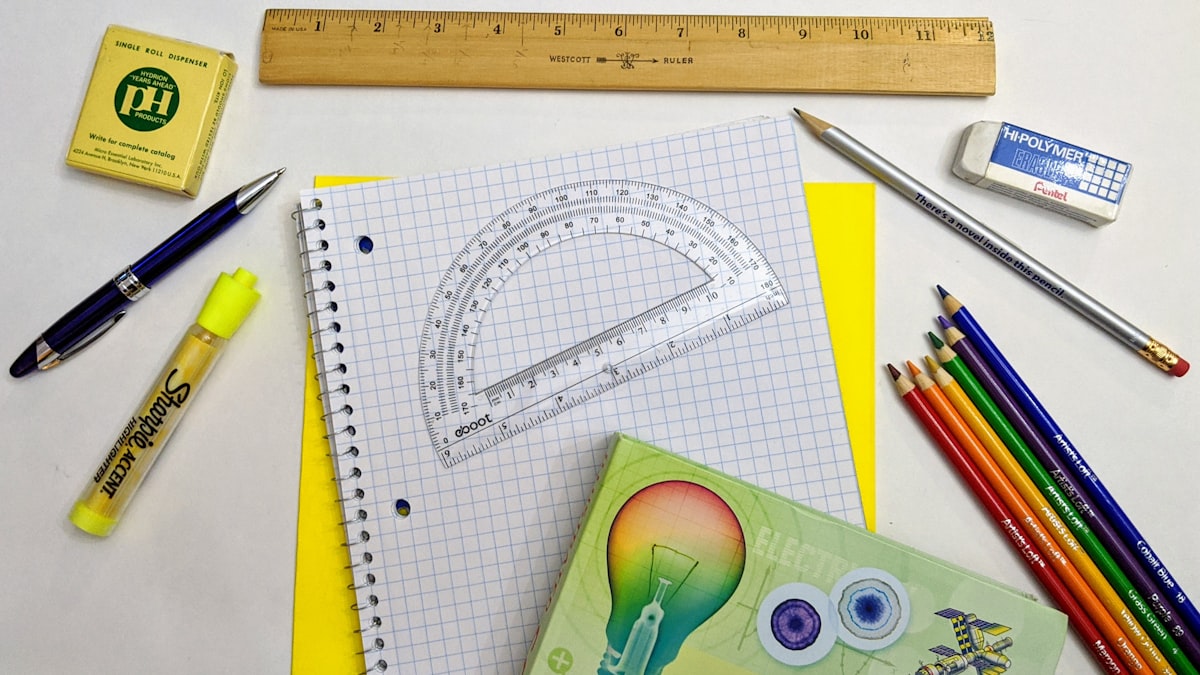
What school supplies do left-handed kids need? Left-handed children need left-handed scissors, fast-drying pens, right-side-bound notebooks, left-handed rulers, and ergonomic pencil grips — tools designed for their natural hand position rather than adapted versions of right-handed products.
Standard school supplies are designed for right-handed use. Left-handed scissors cut from the wrong angle. Spiral notebooks put the coil under the writing hand. Rulers force lefties to read numbers in reverse. These are small problems individually, but together they create daily friction that makes school harder than it needs to be for left-handed children.
This guide covers every major category of school supply, with recommendations for left-handed versions and buying advice for parents and teachers.
Why left-handed children need specific supplies
Left-handed children make up approximately 10 percent of the school population. In a typical classroom of 30 students, three children are writing with their left hand — often with supplies designed around the other 27. The consequences are practical:
- Standard scissors are designed for the right hand's grip. In a left hand, the blades torque away from the cut line rather than into it, producing ragged cuts and requiring extra force.
- Spiral notebooks place the binding under the left hand, creating an uncomfortable ridge that tilts the wrist and makes sustained writing difficult.
- Ballpoint and gel pens with slow-drying ink smear when a left-handed writer's palm passes over fresh text.
- Standard rulers place zero on the left and increase to the right — the opposite of the direction a left-handed child naturally measures from.
None of these problems is insurmountable, and many left-handed children adapt. But adaptation requires effort that right-handed students do not expend, and the cumulative effect over years of schooling can affect confidence, writing development, and attitude toward school tasks. Providing appropriate supplies removes these obstacles so children can focus on learning rather than equipment.
For practical guidance on supporting a left-handed child's writing development, see our full guide on how to teach a left-handed child to write.
Left-handed scissors
Left-handed scissors are the most important and most misunderstood left-handed school supply. The difference is not merely cosmetic. In left-handed scissors, the blades are reversed so that the cutting edges meet correctly when held in the left hand, and the handles are molded for the left hand's grip angle.
A left-handed child using right-handed scissors must twist their wrist to apply enough closing pressure, and the blade geometry actively works against the cutting direction. The result is torn paper, frustration, and in some cases a mistaken belief that the child lacks fine motor skill.
Our full review of the best left-handed scissors covers options in detail, but strong choices for children include:
- Fiskars Kids Left-Handed Scissors — the standard recommendation for primary-age children, with correctly-reversed blades and a soft-grip handle sized for small hands
- Maped Kidi Cut Left-Handed Safety Scissors — rounded safety tips suitable for pre-school and early primary, with an ergonomic grip that provides good control
- Westcott iPoint Left-Handed Scissors — a slightly larger option for older children moving into middle school, with a precision blade and comfortable grip
Schools that buy only right-handed scissors are inadvertently disadvantaging a predictable portion of every class. Stocking a few pairs of left-handed scissors in the classroom is a straightforward accommodation.
Pens and pencils for left-handed children
Pencils with ergonomic grips
Young left-handed children are still developing their grip. Triangular pencils naturally guide fingers into the correct three-finger grip, which is beneficial for all children but particularly helpful for left-handed children who may compensate for writing difficulties with tighter, more effortful grips.
The Stabilo EASYgraph left-handed pencil is designed specifically for left-handed children, with an indented grip zone that guides the left hand's natural finger placement. The triangular body prevents rolling and encourages the hand position that keeps the wrist below the writing line rather than hooking above it.
Fast-drying pens
As children move from pencils to pens in upper primary, ink-smudging becomes the central challenge. Left-handed writers push the pen across the page, with their hand following directly over fresh ink. Slow-drying ballpoint and gel inks smear predictably.
For young writers transitioning to pen use, look for pens with fast-drying gel ink. The Pilot FriXion is a popular choice in schools because the ink is erasable as well as fast-drying, which helps children who are still building consistency. For older children, the Uni-Ball Jetstream's hybrid ink dries in under a second and is an excellent first "real" pen for a lefty.
A full breakdown of ink types, drying times, and brand recommendations is available in our guide to the best left-handed pens.
Pencil grips
Pencil grips are rubber or silicone attachments that fit over the barrel of a standard pencil or pen and guide the fingers into a correct grip. For left-handed children, look for grips that are explicitly designed for left-hand use — these position the indentations for the left hand's thumb and finger placement rather than mirroring a right-handed grip.
The Crossover Grip and Stetro Grip are widely used in occupational therapy for children with grip difficulties. Both come in left-handed versions. They are inexpensive and can significantly reduce the fatigue and cramping that some left-handed children experience during extended writing.
Notebooks and writing pads
The spiral notebook is the standard school notebook format — and it is genuinely uncomfortable for left-handed writers. The spiral sits under the left hand when writing on the right page, forcing the wrist up over the coil. Over a full school day of note-taking, this causes fatigue and can worsen the hook-wrist posture that many left-handed children develop as compensation.
Solutions include:
- Right-side-bound spiral notebooks — notebooks where the spiral runs along the right edge rather than the left. The hand writes on the left page and the spiral is out of the way on the right.
- Top-bound spiral notebooks — the spiral runs across the top, completely avoiding conflict with the writing hand regardless of which page is open.
- Composition notebooks — sewn binding down the center, creating no raised edge on either side. A practical everyday option.
- Loose-leaf binders with paper inserted from the right — standard 3-ring binders work for left-handed writers if pages are written and turned from left to right in the conventional way.
Our guide to the best left-handed notebooks covers specific product recommendations across age groups and use cases, including composition notebooks, art sketchbooks, and revision pads.
Rulers
A standard ruler has zero on the left and increases to the right. When a left-handed student measures, they anchor the ruler with their right hand and read from right to left — which puts the numbers running in reverse relative to their reading direction. This is confusing for young children learning measurement and creates consistent errors.
Left-handed rulers are mirror images: zero begins on the right and numbers increase to the left, so a left-handed student can anchor with their left hand and read naturally in the direction their hand is moving. Left-handed rulers are available in both metric and imperial formats and are a straightforward purchase with an immediately visible benefit for children learning measurement.
For older children doing geometry, look for left-handed protractors, which mirror the degree markings for the same reason.
Art and craft supplies
Pencil sharpeners
Manual handheld pencil sharpeners are typically designed to be twisted clockwise with the right hand. A left-handed child twisting counterclockwise can break pencil tips more frequently. Left-handed pencil sharpeners (reversed rotation direction) or electric sharpeners eliminate this issue entirely.
Paint brushes and art tools
Most art tools — brushes, palette knives, rulers — are symmetrical and work equally in either hand. The primary consideration in art class is seating: a left-handed child seated to the right of a right-handed child will frequently elbow their neighbor during drawing and painting. Ensuring left-handed children are seated at the left end of a row or paired with another left-hander eliminates the problem.
Calligraphy and lettering
Children who develop an interest in calligraphy or decorative lettering will need left-handed nibs and appropriate ink. Our guide to the best left-handed calligraphy sets covers nibs, papers, and inks suited to left-handed calligraphers.
Organisation and desk supplies
Three-ring binders and folders
Standard three-ring binders open from right to left — the natural direction for right-handed users. Left-handed students can use standard binders by simply flipping them so they open from the left side. Alternatively, left-opened binders and folders are available specifically for left-handed students.
Inside the binder, standard dividers and pockets work equally well for either hand. The main practical adjustment is that a left-handed student writing on the binder's note pages may find the rings positioned under the writing hand — using loose paper inserted into the binder and writing separately solves this without needing specialized equipment.
Desk setup
Classroom desks with attached tablet arms are among the most frustrating pieces of equipment for left-handed students. The vast majority have the writing surface on the right side, which is unusable for left-handed writers. Some schools stock a few left-handed tablet arm desks; if your child uses a standard classroom, a portable lapboard or ensuring they sit at a full four-legged desk is the workaround.
Tips for parents
Buy the supplies before school starts
Left-handed school supplies are not typically stocked in general school supply aisles. Purchasing in advance online ensures you have what you need before the school year begins. Most categories — scissors especially — are inexpensive enough that buying a set to keep at home and a set to keep in the school bag is practical.
Talk to the teacher
Many teachers are unaware that standard supplies create extra difficulty for left-handed students. A brief note explaining that your child is left-handed and uses left-handed scissors, a right-side-bound notebook, and a left-handed ruler gives the teacher context to support your child appropriately. Most teachers will respond positively — the information is practical, not demanding.
Let the child lead on hand preference
Some children show a strong, consistent left-hand preference from early childhood. Others take longer to settle into a dominant hand. Do not rush the process or show concern if your child's hand preference seems inconsistent before age five or six. By the time formal writing instruction begins, most children have a clear preference. Provide left-handed tools for the preferred hand and right-handed tools alongside — let the child choose.
Model a positive attitude
Children are perceptive about adult attitudes. Framing left-handedness as an interesting characteristic rather than a problem to solve communicates something important. The fact that approximately one in ten people are left-handed — including many famous scientists, artists, athletes, and world leaders — is worth sharing in an age-appropriate way.
Back-to-school checklist for left-handed children
- Left-handed scissors (child-sized, safety tips for younger children)
- Triangular or ergonomic pencils (Stabilo EASYgraph left-handed recommended)
- Fast-drying pens (when transitioning from pencils)
- Left-handed pencil grips (optional but helpful for writers with grip difficulties)
- Right-side-bound or top-bound spiral notebook
- Left-handed ruler (metric and/or imperial)
- Left-handed protractor (from upper primary onward)
- Composition notebook as a general-purpose alternative to spiral-bound
- Lapboard or portable writing surface (if desk setup is problematic)
Left-handed school supplies as gifts
A well-curated set of left-handed school supplies makes a thoughtful and practical gift for a left-handed child starting primary school or moving up to secondary. Bundling scissors, a notebook, and a set of pens in a pencil case sends a clear, positive message that their handedness has been noticed and considered. Our guide to gifts for left-handed people has ideas across all age groups and price ranges.
Frequently asked questions
At what age should I buy left-handed supplies for my child?
Most children show a clear hand preference by age three to four, though it is normal for this to become fully consistent closer to five or six. The most important purchase at early ages is a pair of left-handed safety scissors, as right-handed scissors create immediate difficulty and frustration for left-handed children who attempt cutting activities. Triangular pencils and ergonomic grips are useful from the start of formal writing. Specialist notebooks and rulers become more relevant as children begin sustained writing in primary school.
Do schools stock left-handed supplies?
Most mainstream schools do not proactively stock left-handed alternatives across all supply categories. Some schools keep a small number of left-handed scissors available, particularly in early years classrooms, but this is not universal. It is worth asking the school at the start of the year what they have available and sending in supplies your child needs. Schools are generally receptive to this — it is a simple accommodation with a clear benefit.
Are left-handed scissors really that different from regular scissors?
Yes, significantly. The difference is in the blade orientation and the handle design. In left-handed scissors, the top blade sits on the left rather than the right, which means the blades squeeze together correctly when held in the left hand. In right-handed scissors used in the left hand, the blades bow apart under grip pressure, making clean cutting difficult or impossible and requiring much more force. Left-handed children using right-handed scissors are often assumed to have poor fine motor skills when the issue is actually the tool, not the child.
What is the best pencil for a left-handed child learning to write?
The Stabilo EASYgraph left-handed pencil is widely recommended by occupational therapists and teachers for left-handed children learning to write. It has a triangular cross-section that guides finger placement and an indented grip zone specifically contoured for the left hand. For younger children who need a thicker barrel, the Stabilo EASYcolors left-handed jumbo crayon/pencil is a good pre-writing option. For general everyday use, any triangular pencil in the 2B hardness range (softer than HB) works well — softer pencils require less pressure, which reduces fatigue and smearing.